Showing posts with label HACKING WINDOWS. Show all posts

Monday, July 23, 2012

Hcon Security Testing Framework (HconSTF) v0.4 – Fire Base

HconSTF is an Open Source Penetration Testing Framework based on different browser technologies, Which helps any security professional to assists in the Penetration testing or vulnerability scanning assessment. It contains webtools which are capable of carrying out XSS attacks, SQL Injection, siXSS, CSRF, Trace XSS, RFI, LFI, etc. It could prove useful to anybody interested in the information security domain – students, security professionals, web developers and so on...


Features :

  •   Categorized and comprehensive toolset
  •  Contains hundreds of tools and features and script for different tasks like SQLi, XSS, Dorks, OSINT to name a few
  •   HconSTF webUI with online tools (same as the Aqua base version of HconSTF)
  •   Each and every option is configured for penetration testing and Vulnerability assessments
  •   Specially configured and enhanced for gaining easy & solid anonymity
  •   Works for web app testing assessments specially for OWASP top 10
  •   Easy to use & collaborative Operating System like interface
  •   Multi-Language support (feature in heavy development translators needed)


You can download HconSTF 0.4 beta here:


HconSTF_v0.4_Freedom_portable.exe


Saturday, February 4, 2012

CEH – Certified Ethical Hacker v7 Certification Training


 This CEH Certification will fortify the application knowledge of security officers, auditors, security professionals, site administrators, and anyone who is concerned about the integrity of the network infrastructure. CEH candidates will be immersed into an interactive network hacking environment where they will be shown how to scan, test, hack and secure their own systems. Candidates will begin by understanding how perimeter defenses work and then be lead into scanning and attacking their own networks. No real network is harmed. CEH candidates then learn how intruders escalate privileges and what steps can be taken to secure a system. Candidates will also learn about Intrusion Detection, Policy Creation, Social Engineering, DDoS Attacks, Buffer Overflows and Virus Creation. Learn the art of penetration testing (pen testing) in order to create network intrusion vulnerability prevention plans.


Topics Covered in Our Ethical Hacking Training
  • Developing the hacker’s mind
  • Network surveying
  • Port scanning
  • System identification/OS fingerprinting
  • Vulnerability research and verification
  • Service identification
  • Internet application testing
  • Document grinding
  • Recognizing security issues within an organization
  • Performing legal assessments on remote/foreign networks
  • Examining an organization for weaknesses as through the eyes of an industrial spy or a competitor
  • Implementing the right tools for each task of the Methodology
  • Competitive Intelligence
  • Exploiting vulnerabilities remotely
  • Examining appropriate countermeasures to thwart malicious hacking
CEH v7 Training Audience

The Certified Ethical Hacker certification will fortify the application knowledge of security officers, auditors, security professionals, site administrators, and anyone who is concerned about the integrity of the network infrastructure.
Certified Ethical Hacker Bootcamp Pre-Requisite

A Certified Ethical Hacker bootcamp training class candidate should have at least two years of information technology experience, a strong working knowledge of TCP/IP, and a basic familiarity with Linux or strong working support knowledge of Microsoft XP or Vista.

  Download torrent  

Dun forget to share this blog if u think we helped you and/or if u like this blog share it join our facebook page to get upadates.. :)

Tuesday, November 29, 2011

(Ebook - English) Access To Other People's Systems Made Simple


Book 1:

The majority of successful attacks on computer systems via the Internet can be traced to exploitation of security flaws in software and operating systems. These few software vulnerabilities account for the majority of successful attacks, simply because attackers are opportunistic – taking the easiest and most convenient route. They exploit the best-known flaws with the most effective and widely available attack tools. Most software, including operating systems and applications, comes with installation scripts or installation programs. The goal of these installation programs is to get the systems installed as quickly as possible, with the most useful functions enabled, with the least amount of work being performed by the administrator. To accomplish this goal, the scripts typically install more components than most users need. The vendor philosophy is that it is better to enable functions that are not needed, than to make the user install additional functions when they are needed. This approach, although convenient for the user, creates many of the most dangerous security vulnerabilities because users do not actively maintain and patch software components they don’t use. Furthermore, many users fail to realize what is actually installed, leaving dangerous samples on a system simply because users do not know they are there. Those unpatched services provide paths for attackers to take over computers.. TO read more download eBooks....


Book 2:

Google: A Hacker's Best Friend
In the last few years a number of news articles appeared that warned of the fact that hackers (or
crackers if you will) make use of the google search engine to gain access to files they shouldn't be
allowed to see or have access to. This knowledge is nothing new to some people but personally I have
always wondered how exactly a thing like this works. VNUnet’s James Middleton wrote an article in
2001 talking about hackers using a special search string on google to find sensitive banking data:
"One such posting on a security newsgroup claimed that searching using the string 'Index of /
+banques +filetype:xls' eventually turned up sensitive Excel spreadsheets from French banks. The
same technique could also be used to find password files"[1]
Another article that appeared on wired.com told us how Adrian Lamo, a hacker who made the news
often the last couple of years, explained that google could be used to gain access to websites of big
corporations... download eBooks to read more..


This .rar file contains 2 eBooks to download it link and password is given here have fun ! Don't forget to hit like and share it :)


► PASSWORD:  HACKRICH.BLOGSPOT.COM

Share it :)

Wednesday, July 13, 2011

HACKING WINDOWS USING SET AND BACKTRACK 5


What is Social Engineering Toolkit ?
The Social-Engineer Toolkit (SET) is specifically designed to perform advanced attacks against the human element. SET was designed to be released with the http://www.social-engineer.org launch and has quickly became a standard tool in a penetration testers arsenal. SET was written by David Kennedy (ReL1K) and with a lot of help from the community it has incorporated attacks never before seen in an exploitation toolset. The attacks built into the toolkit are designed to be targeted and focused attacks against a person or organization used during a penetration test.


Actually this hacking method will works perfectly with DNS spoofing or Man in the Middle Attack method. Here in this tutorial I’m only write how-to and step-by-step to perform the basic attack, but for the rest you can modified it with your own imagination.  


In this tutorial we will see how this attack methods can owned your computer in just a few steps…
The success possibility of this attack depend on victim browser. If the victim never update their browser, the possibility can be 85% or more. 


Requirement : 
1.  Backtrack 5 or Backtrack 4


Step By Step : 
1. Change your work directory into /pentest/exploits/set/ 


2. Open Social Engineering Toolkit (SET) ./set and then choose "Website Attack Vectors" because we will attack victim via internet browser. Also in this attack we will attack via website generated by Social Engineering Toolkit to open by victim, so choose "Website Attack Vectors" for this options. 


3. Usually when user open a website, sometimes they don't think that they are opening suspicious website that including malicious script to harm their computer. In this option we will choose "The Metasploit Browser Exploit Method" because we will attack via victim browser. 


4. The next step just choose "Web Templates", because we will use the most famous website around the world that already provided by this Social Engineering Toolkit tools. 


5. There are 4 website templates Ready To Use for this attack methods, such as GMail, Google, Facebook, and Twitter. In this tutorial I will use Google, but if you think Facebook or Twitter more better because it's the most accessed website, just change into what do you want. 


6. For the next step…because we didn't know what kind of vulnerability that successfully attack the victim and what type of browser, etc, in this option we just choose "Metasploit Browser Autopwn" to load all vulnerability Social Engineering Toolkit known. This tools will launch all exploit in Social Engineering Toolkit database. 


7. For payload options selection I prefer the most use Windows Shell Reverse_TCP, but you also can choose the other 
payload that most comfortable for you


8. The next step is set up the Connect back port to attacker computer. In this example I use port 4444, but you can change to 1234, 4321, etc 


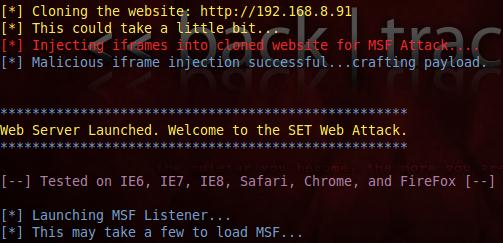
9. The next step just wait until all process completed and also wait until the server running. 


10. When the link given to user, the victim will see looks-a-like Google (fake website). When the page loads it also load all malicious script to attack victim computer. 


11. In attacker computer if there's any vulnerability in victim computer browser it will return sessions value that mean the exploit successfully attacking victim computer. In this case the exploit create new fake process named "Notepad.exe". 


12. To view active sessions that already opened by the exploit type "sessions -l" for listing an active sessions. Take a look to the ID…we will use that ID to connect to victim computer. 


13. To interract and connect to victim computer use command "sessions -i ID". ID is numerical value that given when you do sessions -l. For example you can see example in picture below. 


14. Victim computer already owned. I'm practice to create this tutorial using Virtual Machine so it will not harm other computer and also you can doing a lot of experience with your OS.


Related Posts Plugin for WordPress, Blogger...

IP info

hAckRich

Tags

study (19) education (18) coding (11) Codes (9) ciphers (9) cryptology (9) CRYPTOGRAPHY (8) Hacking Tutorials (5) Ethical hacker/hacking (4) Exploits and Incident Handling (4) HACKING WINDOWS (4) Make A Cipher (4) Windows (4) password breakers/crackers (4) Dictionary (3) Ebook (3) Facebook (3) Facebook Emoticons (3) Google Dork (3) Google Hacks (3) facebook symbols (3) php hack (3) tools (3) ASCII art (2) Facebook Animated Gif Image Status (2) GRE (2) GRE Dictionary (2) Hack a Website (2) IELTS (2) Java: A Beginner's Guide (2) Password Cracking (2) Password Recovery (2) SOCIAL ENGINEERING TOOLKIT (2) Session hijacking (2) find the vulnerability (2) java (2) password-auditing (2) password-cracker (2) php (2) Abel (1) Backtrack 5 (1) Barron’s GRE word list (1) Breaking Ciphers (1) CIPHERTEXT (1) CRYPTANALYSIS (1) Caesar's Shift Cipher (1) Cain (1) Cain and Abel (1) Crypters Binders RC4 (1) DOS (1) Facebook Chat Text Generator (1) Fast leech generator (1) Hacking Tools (1) HconSTF (1) List of best anonymizers (1) Make fake virus (1) Number Shift Cipher (1) One Pig's Pen (1) RFI (1) Remote file inclusion (1) SEO (1) SQL injection (1) Security 504 Hacker Techniques (1) Steal/trace ip (1) The Key (1) The Rail Fences (1) Toefl (1) Uses of proxy server (1) Virus (1) Vocabulary Word List (1) Winding Way Cipher (1) blog tips (1) brute force (1) brute forcing. (1) brutus (1) brutus-aet2 (1) brutus-aet2.zip (1) brutus-password-cracker (1) bypass web-filters (1) chat (1) command prompt (1) cookie stealing (1) crackers (1) e (1) fast download (1) hacking-software (1) hot file (1) improve site (1) ip catcher (1) ip tracker (1) leech (1) leecher (1) list of proxy servers (1) mail (1) mega upload (1) mobile (1) network-sniffing (1) rapid share (1) regular download link into premium (1) serial keys 94fbr (1) symbols (1) th3j35t3r's DOS tool (1)

Hackrich

welcome

☁ Partners Link Cloud ☁